Why are we so complacent

Having just read about the 30% decline of wildlife on this planet  since 1970 it seems unfathomable that we can allow it to continue. But we do. (That figure of 30% can be a little misleading since in tropical areas it rises to a 60% loss which is horrendous).

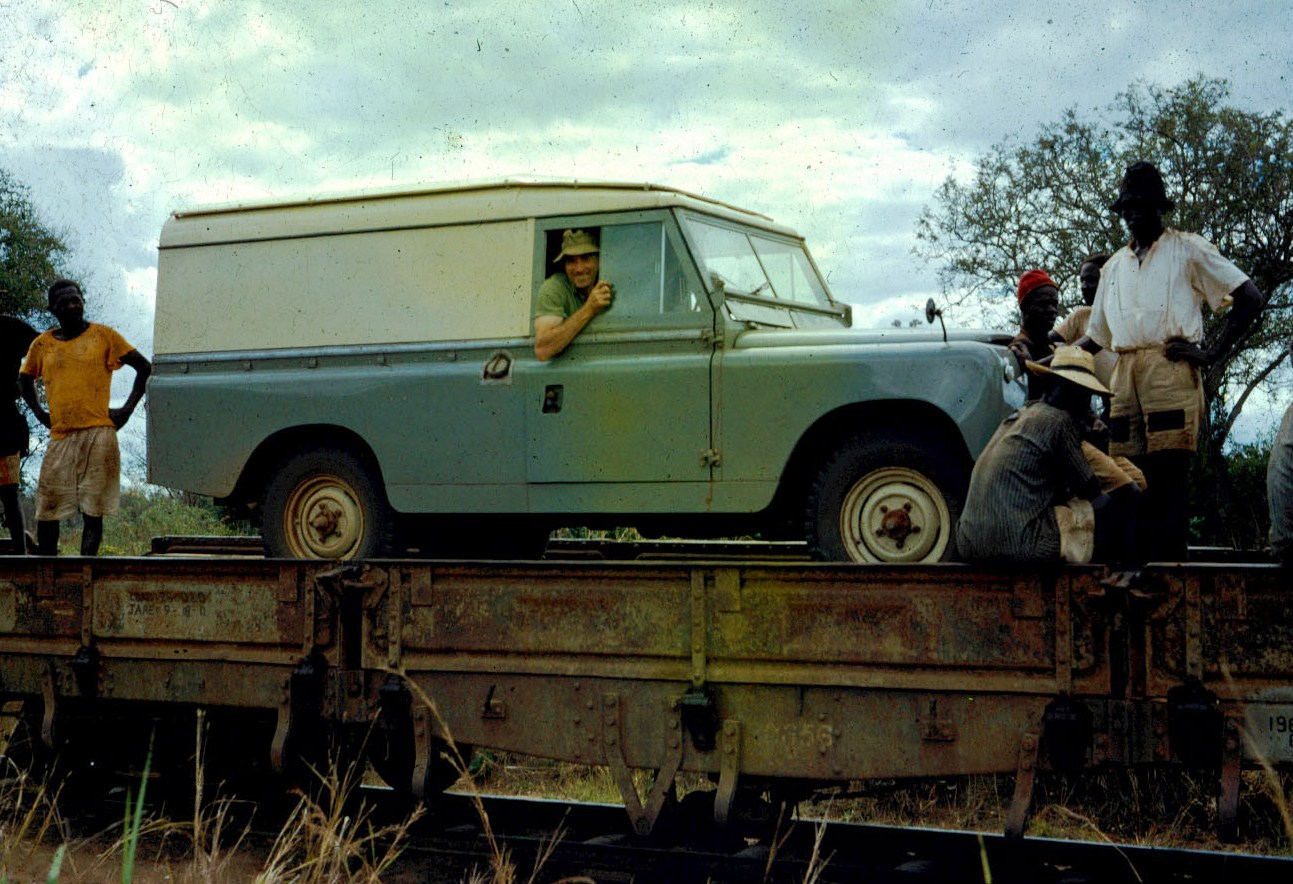
When my dad first moved to East Africa in 1952 he, like many other white people over there, became one of Africa’s hunters. It didn’t take him long to realize what was happening to the wildlife and he soon turned to the camera to document rather than hunt and became a passionate advocate of wildlife. This was in the late 50s and early 60s so if everyone else followed suit, we’d have already worked out what we needed to know by 1970.

Dad, back in the late 50s in East Africa – somewhere
It obviously didn’t happen though because we are decimating wildlife at unprecedented rates despite a slew of conservation societies around the world trying to educate us not to.

So what is happening, how are mucking things up and why aren’t we fixing things?

Of course, the problems run much deeper than saying “take care of the environment and the animals in it”. Just off the top of my head we have land loss and degradation, pollution, bush meat trade, souvenier collecting, removal of major predators which causes grazers to flourish and destroy the land through overeating, illegal fishing and hunting, legal fishing and hunting (which can be managed well but in some countries are NOT).

Add to this our consumer society where we absolutely must have the latest whizz bang thing just to keep up with the Joneses or to feel like our life has meaning, and of course the built in obsolescence which most modern electronic and mechanical devices have. Let’s face it, our repairmen have become fitters because it’s cheaper and easier to fit a new one and throw the broken one away rather than repair it. You only have to look on the side of the suburban and country roads to see the discarded TVs and computer monitors to illustrate this point.

I’m one of those who likes to keep things upbeat but when I read that awesome wildlife artist Eric Wilson‘s 2007 blog post about the imminent demise of the tiger, it really hit home. There are massive efforts underway to prevent this animal going the way of the dodo and many other extinct species and yet even he, a man who cares deeply for this animal and is part of those efforts, has just about given up hope.

So why is it that we feel defeated? Here’s an example. I routinely try to turn lights off and use as little fuel as possible yet BHP is planning to expand the Roxby Downs mine in South Australia, my home state, and has stated that they will need to use one million litres of diesel per day for the next six years simply to remove the overburden of this expanded part of the mine (overburden is the rubble that needs to be removed before you even start to get to the valuable bit). This is the equivalent of doubling the amount of cars on Adelaide’s roads. I’m not even going to comment here about whether this is a good thing or a bad thing since mining brings prosperity to a depressed economy, but it goes to show how little the caring individual can do. (Of course, responsibly run mines can be a good thing – we wouldn’t want to be hypocrites since we all use the products that come from mining. However, many mines around the world whose products we use everyday are not run responsibly – what is in your computer and mobile phone if not coltan, the ore that is routinely mined in the Congo and then stolen by surrounding countries? This same mining practice that has displaced whole neighborhoods and decimated their income so that they now have to resort to the bush meat trade so they can live. And what do they kill? Well, they live where the mountain and lowland gorillas are and that’s what they kill!)

However, just because we feel like we can’t do much doesn’t mean we shouldn’t. We are the example for the next generation. We are the people who can bring about change but in order to do that we need to become engaged. There is no room for complacency in the fight to keep our wild heritage. We need it more than it needs us. Maybe my generation will scrape by but subsequent ones won’t. And I don’t want to just scrape by while magnificent species vanish. Some people say “Imagine being the generation that had to explain to their kids why the tiger is no longer with us” but I’d rather say “Imagine being the generation that saved the tiger”!! Let’s not end up with the chimps “turning back in anger” as in my pastel sketch below.

“Turn back in anger”

A couple of doggy stories, the grateful mutt and the fierce softy.

Story #1

My son is a great one for trawling through the internet looking at cute animals and he told me of one that was rescued by someone, a stray that would surely have died. I decided to tell him my own little story.

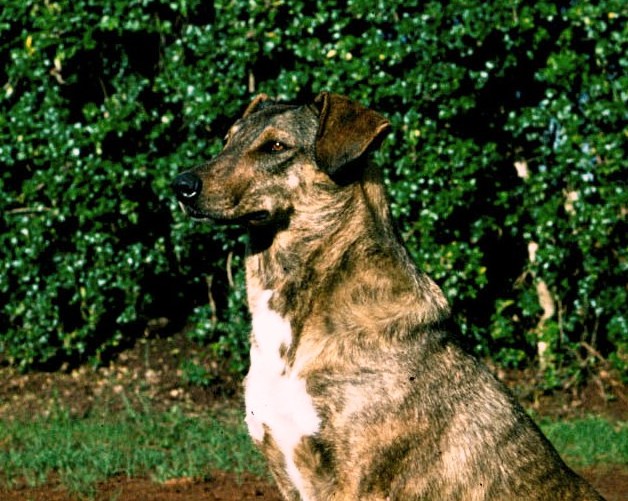
My dad was as bad as me for not being able to see an animal suffer. We already had a dog and didn’t really want another. However, he pulled into his garage at work at the railways in Nairobi in Kenya and heard a whimpering coming from the back of the garage. He went over to see this young dog, older than a puppy but still young. It was what people called a “shenzi”. which is the Swahili word for savage, useless, uncouth, barbarous, uncivilized and also half breed. We know them as mongrels or mutts. This one tried to growl at my dad, a sort of “leave me to die in peace” growl, because die it surely would have. It was totally emaciated. He backed off, went and did his day’s work and decided to see what the dog was like in the evening, thinking he’d have to remove the body. The dog was one of the thousands of strays that wandered the streets of Nairobi and she was in terrible condition. However, she was still curled up in the same spot when he went back and this time he managed to stroke her. Well, that was it! He had to see if she could be rescued. He put her in the back of his car and came to school to pick me up on his way home.

She could barely stand up and when I saw her I instantly fell in love. She was so skinny all her ribs were not only showing but were extremely prominent. A healthy dog’s back is arched upwards but her’s hung in a concave fashion with no strength.

We took her home and wondered what our Alsatian would do. No need to worry, Gina was good as gold. We fed them both and the most amazing thing happened – Tessa, our new dog, scoffed all her food and Gina stood back and allowed Tessa to move on to her own bowl. It was incredible and I barely believe it even now, forty years later.

We thought Tessa had eaten too much but she survived the night. Bit by bit she got her strength back and the true athlete was finally revealed. She was a gorgeous dog – I love mongrels – and she had a grateful nature that seemed to say “Yes, I know what I was and I know it was you who saved me”. I’ve had some great dogs in my time, got one right now in fact, but Tessa was the best. It’s not just a guy reminiscing about his youth and the pets he had. She was truly special.

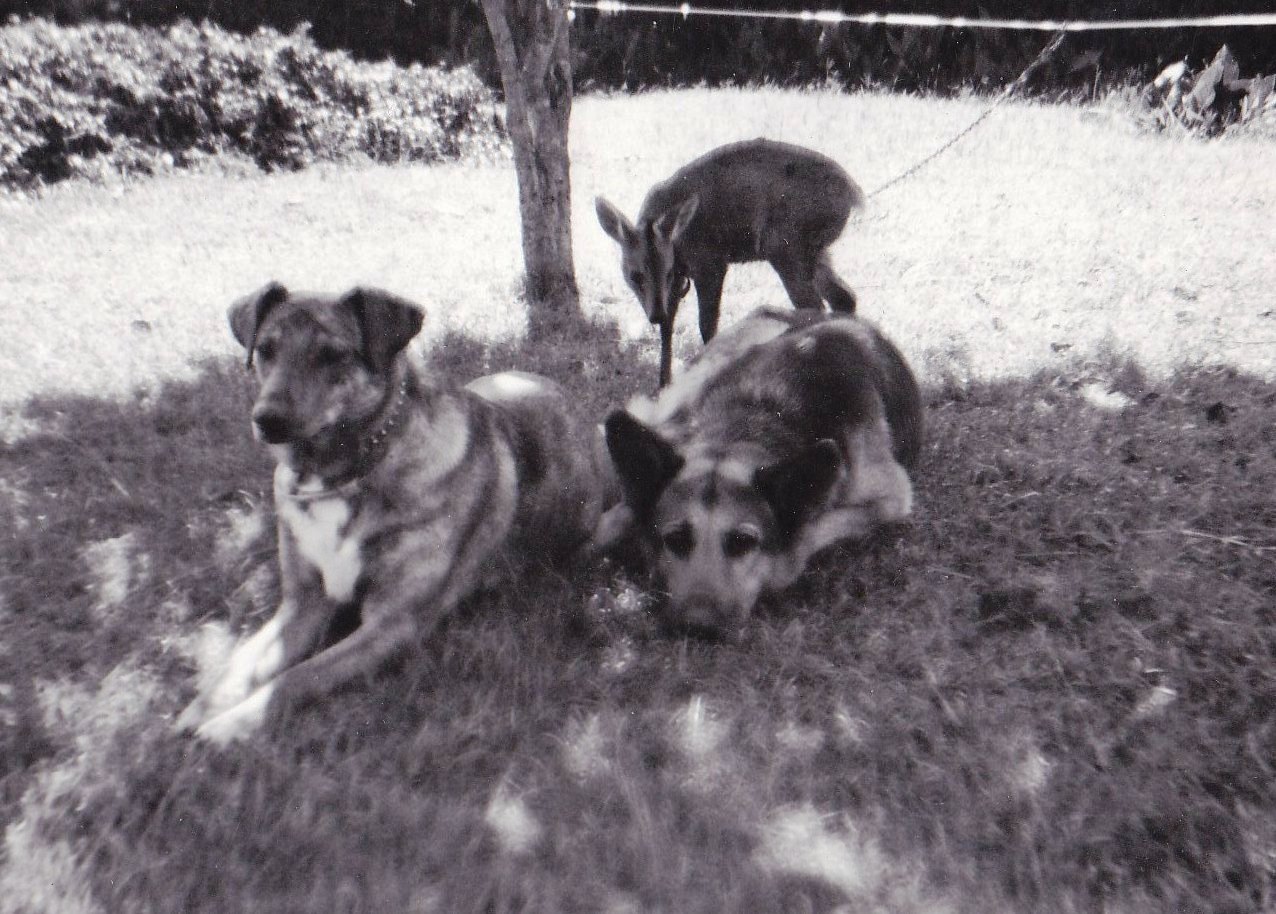
And what of Gina, the dog who gave Tessa her own food on that first night? Yes, she was pretty darn special too. Here they both are with our tame lawn mower, Bambi the duiker.

______________________________________________________________________________

Story #2

A farmer sold up and moved. He had a boxer dog which he gave to us as he could no longer look after it. This was a brute of a thing, a very masculine guard dog, fiercely protective of its territory. We had about an acre of land in Nakuru, near the iconic lake of the same name, home to millions of flamingos, but this acre wasn’t enough for Dan the boxer. He used to go nuts when people walked along the street past our property and one day he ran out there and took a chunk out of a guy’s leg. Poor bloke was only walking home from the duka (shop). My mum was mortified and sat this guy down, apologising profusely explaining that it wasn’t really our dog and it was used to a much bigger property. She patched his leg up all the while listening to this guy’s voice, stuck on repeat saying “great guard dog, great guard dog”. Far from being indignant, he was actually impressed with Dan.

So you’d think Dan would be someone to watch out for around the rest of our menagerie of strange animals. Not so! He loved our Mackinders Eagle Owl. And it loved him!

Inaugural ISSA show

As can be seen on the International Society of Scratchboard Artists website, the deadline for entries to the Inaugural show in Glen Ellen, in the beautiful Sonoma Valley wine growing region of California, just outside San Francisco, closes on the 25th April. I have my entries in and hope many other people do too. It’s going to be a great show. I’ll be flying from Australia to attend the artists opening day at the venue, The ARTHouse Gallery (the link I’ve provided takes you straight to the work of Master Scratchboard Artist and all round cool gal Diana Lee, already represented by the gallery). This will be on the 7th July, and I will then be attending the two days of workshops where seven scratchboard artists (including the legendary Charlie Ewing) will share their techniques (I will be doing a two hour segment myself). This will be at the Sebastapol Center For the Arts on the 8th and 9th. I can’t wait to meet old and new friends and learn from them. Of course, we’ll get to see a reasonable chunk of the west coast on holiday either side of the show.

Here’s my latest piece, a small scratchboard sketch of a Cape Buffalo, and I’m currently working on a series of ‘in your face’ kangaroos, along the lines of my previous emu series

Be adventurous with your references

I see a lot of wildlife art based around the “Big Five” or other large animals that the public identifies with. Tigers, lions, leopards and elephants are staples of many artists, and I have drawn or painted them many times too. But I believe it’s a mistake to rely on these. The natural world is jam packed with wonderful fauna (and flora) ranging from massive to miniscule.

My dad worte a book about East African reptiles and amphibians and if he had lived longer, he was going to write a second book called “Not only Elephants”. He was of the same opinion as me and this book was going to be dedicated to the animals that people often missed like shrews, zorillas, tortoises, rock hyrax and so many others. Tourists used to come to East Africa in search of the big five (elephant, black rhino, leopard, lion and buffalo – grouped together because they were the most dangerous animals to hunt) and in their fascination of these large animals, they often missed so much beauty that flashed by them as they motored along in their zebra striped wildlife viewing vehicles (painted in stripes more for the appeal to the tourists than the camouflage they afforded the vehicle).

I was in a similar vehicle recently, and some of my fellow occupants would be staring into the distance for a sighting of an elephant or leopard whilst missing lilac breasted rollers and malachite kingfishers. They would look at me as if I was mad as I turned over stones looking for lizards, scorpions and snakes. Ok, maybe I am mad but look at the smaller creatures in our world and I defy anyone to prove to me that the larger creatures are more wonderful.

Thus, I also believe it’s our duty as wildlife artists to research and educate people about these animals. I’ve recently been challenged to move towards the less fashionable animals so here are a couple of new pieces. Meerkats are quite popular nowadays, in part due to that amazing TV series “Meerkat Manor”. Here’s my take on a meerkat looking out for predators. I’ve included specks of dirt on the meerkat’s head to show that, whilst they are always alert for danger, they are constantly digging for food and shelter.

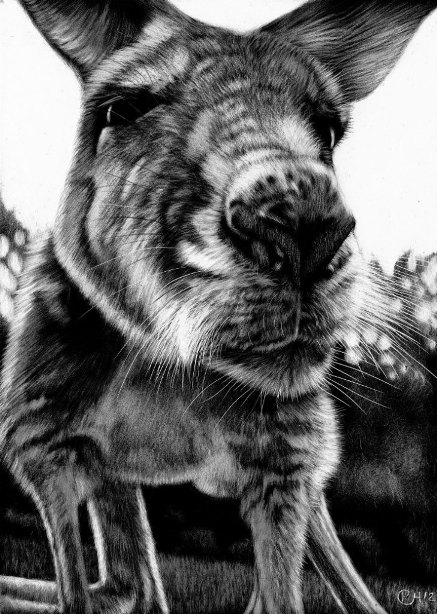
And an even less fashionable animal, an iconic Australian species. The grey kangaroo isn’t depicted too often in art simply because they look so cute and therefore artists shy away from them. I do too but I managed to coax one to come right up to my face and I caught this distorted “pleased to meet you” kind of look.

What a strange place Etosha is

Here are a couple of scratchboards from my time in Etosha National Park in Namibia. The first is a group of Elephants around the waterhole at Halali. It’s called “Total Protection” because of way the young are protected by the adults. It’s created by fibreglass brush removing the ink in a soft focus fashion, then adding ink back in (diluted in an airbrush), re-scratching, re-inking, re-scratching, re-inking etc as many times as it takes to get the effect I need. Finally I’ve sprayed the whole thing sepia to keep the monochrome effect but also add that little bit of old time feel to it and the sunshine and dust of Africa.

“Total Protection”

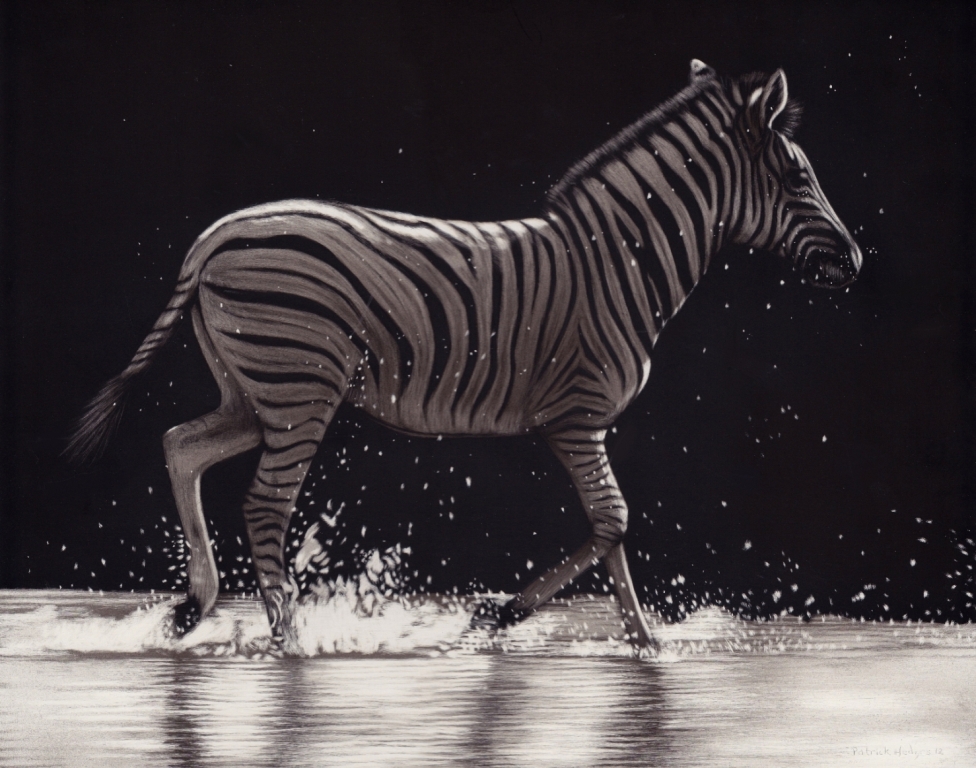
The second piece is a young zebra trotting through the water after its mum in a piece called “Water Baby”. It’s from a zebra at the waterhole at Okaukuejo.

“Water Baby”

So why is Etosha a strange place? Well, it’s an extremely dry place. It has a vast salt pan which is eerie and beautiful. The park has very little precipitation and as such it doesn’t support a lot of the animals you’d expect. It has no hippo, no buffalo and no crocodiles. Nip across the border into Botswana and in the Okavango Delta or Chobe National Park you’ll encounter as many hippos, buffalo or crocodiles as you might wish to see. Here’s a croc I photographed at Chobe. Believe it or not, this is in the wild and I’m not using a zoom. I’m literally a metre away from this large croc. However, I’m in a boat and it isn’t. It’s also just been fast alseep and is simply releasing heat through it’s open jaws so I’m neither being brave nor foolhardy.

So what’s going on in Etosha? You’d expect, with all that water in my pieces of art, to see all of the missing animals. No, these are man made waterholes, specifically created from boreholes to draw the animals to them in large numbers so we can get a good look at them. It works too. There were so many elephants at Halali, scores of zebra coming to drink all day at Okaukuejo, and at another waterhole, Namutoni, the best you can come to seeing a large predator is the python that swims there yet the air is thick with birdlife.

Is Etosha worth the trip? You bet it is! Not only do you get to see an abundance of wildlife at these waterholes, but if you venture out into the arid areas, you’ll see plenty from little dikdiks to the gorgeous lilac breasted roller, male oryx sparring for dominance, lion and many other animals. If your main love is monkeys however, you’ll be disappointed. There are none at all. In fact the campground pests aren’t monkeys here but go-away birds, red-billed hornbills and jackals – what a fabulous camping experience when those are considered pests!!

Me on the quiet and eeire Etosha Pan